Twenty Metres and a Red Light: Vehicle Graphics That Work Parked and Moving
There is a moment, usually around 7.40am on a wet A-road, when a van's graphics get their only real audience of the day. Someone is behind it at a set of lights, half-awake, with about four seconds to spare. That is the whole brief. Everything else — the show car park, the client visit, the LinkedIn photo of the team standing next to it — is a bonus round.
Most vehicle liveries are designed as if the van were a poster on a wall, viewed head-on by a patient reader. It is not. It is a moving object seen at an angle, often in spray, frequently through a dirty windscreen. Getting it right is less about taste and more about accepting that the panel has two jobs and they do not overlap neatly.
Two speeds, two layers of information
Design the side panel in two tiers. The first tier is the road-speed layer: one idea, huge, high contrast, readable in a glance and a half. The company name, or a single proposition, in a heavy sans with generous spacing. No script faces, no hairline rules, no gradients that dissolve into the background at 40mph.
The second tier is the parked layer: the services list, the proof points, the website, the QR code. This is the stuff that only works when the van is stationary and someone has a coffee in their hand. It can be small, dense and detailed — but keep it below the midline and away from the wheel arches, where road spray and kerb scuffs do their worst.
The mistake is to treat both tiers as equally important. At 60mph the second tier is decoration. At a standstill the first tier is a nice logo. Neither is wrong, but you have to decide which one you are buying.
Type sizes that survive the M25
On a standard panel van side, a brand name set at roughly 150–200mm cap height is legible from around 20–25 metres in good light. A supporting line needs 50–75mm to hold up at the same distance. Anything below 30mm is a detail for the parked audience, and should be positioned where a standing adult can read it without crouching.
Contrast matters more than colour choice. Dark vinyl on a white van is the easy win; white on a dark van is fine in daylight but turns to mush in low sun or rain. If your brand palette is pale-on-pale, pick a contrasting outline or a colour block rather than trusting the eye to do the work.
Cast, calendered and the rivet problem
The material spec is where most van graphics fail, and they fail quietly, at the edges, over about eighteen months. Cast vinyl conforms to curves, recesses and rivets without lifting. Calendered vinyl is cheaper and perfectly good on flat panels, but it will tent over a rivet line and eventually let water in. On a van with any curvature — and most have some — cast is the safer spend.
Laminate over the top, and match the laminate to the vinyl: cast over cast, calendered over calendered. A matte laminate reads better in direct sun and looks more considered; gloss has more punch and hides dirt slightly better. If the van works in urban areas or carries a lot of brand equity, an anti-graffiti laminate is worth the uplift.
British weather, jet washes and the edge seal
Rain is not the enemy. Traffic film, road salt, tree sap and the occasional seagull are. The single most useful thing you can ask a installer for is a post-heated edge — a proper pass with a heat gun along every cut line and recess so the adhesive flows and seals. Edges that are not sealed are the first thing to lift, and once water gets behind vinyl it travels.
Give the driver a laminated wash card for the glovebox. Hand wash with a pH-neutral shampoo, keep a jet wash lance at least 300mm from the panel, use a 40-degree fan, and never point it at an edge at 90 degrees. Traffic film remover at full strength will dull a laminate over a couple of years; at the correct dilution it is fine. None of this is glamorous, but it is the difference between a livery that lasts the lease and one that looks tired by the first MOT.
The lease problem, handled properly
A leased van has to go back in a condition the funder recognises. That means written permission before anyone touches the paint, a clear agreement about who pays for removal, and a professional removal at the end of term — not a hairdryer and a Saturday afternoon.
For short campaigns, low-tack removable vinyl is the sensible route. For a full three- or four-year term, cast vinyl applied by an accredited installer is fine, provided it is removed within the manufacturer's stated window. Photograph every panel before installation and again after removal. Keep the paperwork. This is the boring paragraph that saves a four-figure charge at handback.
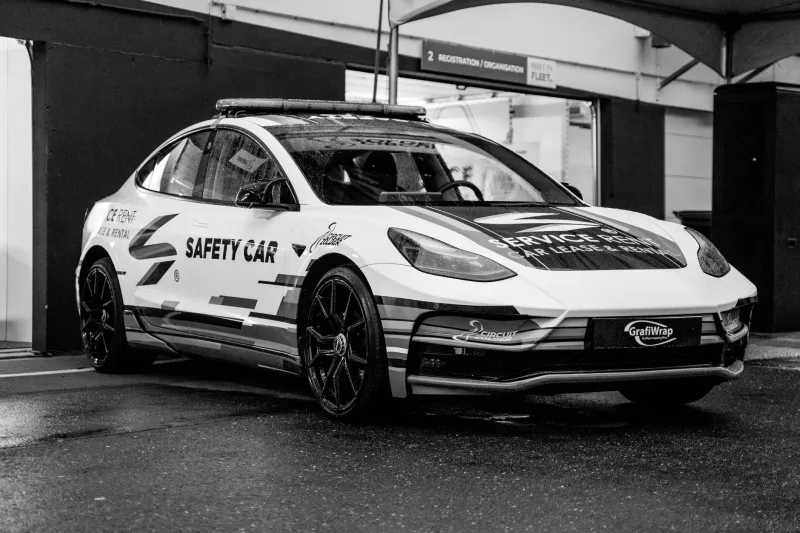
There is also a legal side worth knowing. Do not cover lights, reflectors, mirrors, number plates or the swept area of the wipers. Keep front side windows clear enough for lawful visibility. Do not use red reflective material facing forward or white reflective material facing rearward, and do not mimic emergency service markings — that is an offence, not a design choice. If the van is over 3.5 tonnes or run for hire and reward, operator licensing applies regardless of the livery, so do not let the graphics imply a status the paperwork does not support.
The handover moment
At a show, the van is often the first thing a visitor sees and the last thing anyone plans for. Park it where the side panel faces the approach, not nose-in to a hedge. If you have a removable event panel, use it — a magnetic or low-tack overlay carrying the stand number and a show-specific offer stops the daily driver advertising last month's exhibition.
And keep the QR destination live for the duration of the campaign, with tracking on it. A QR code that lands on a generic homepage is a dead end; one that lands on a booking page or a show-specific landing page tells you whether the van is actually earning its keep.
A short spec checklist
- One message at 20 metres, with cap heights sized for the road
- Detailed information below the midline, out of the spray zone
- Cast vinyl on curves and recesses, post-heated edges
- Laminate matched to vinyl, with a wash card in the glovebox
- Written lease permission and a professional removal booked in advance
- Clear windows, lights, plates and reflectors left uncovered
- An event overlay plan and a tracked QR destination
The van will cover 20,000 miles this year whether you design it or not. The only question is whether any of those miles are doing sales work.