Nobody Queues Where They Can't See: Wayfinding That Works at Collect and Returns Counters
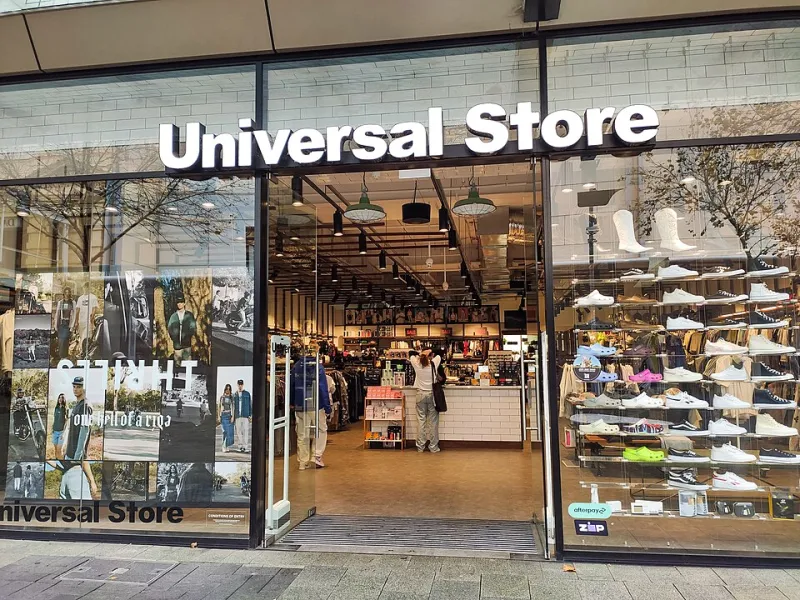
Photo: Samuel Wiki, CC0, via Wikimedia Commons
There is a stretch of floor in most UK stores that no designer ever gets briefed on. It sits two or three metres in front of the click-and-collect desk, or the returns hatch, or the service counter that does a bit of everything. Customers arrive there at speed, holding a phone, dragging a child and a bag, and they have about four seconds to work out where to stand.
That gap is where wayfinding quietly fails. Not because the signs are badly printed, but because nobody stood where the customer stands and looked.
Start with the sightline, not the sign
Before anyone opens a design file, walk the route. Come in through the entrance a customer uses, turn the corner they turn, and stop at roughly 1.55 to 1.6 metres eye height — adult average, and remember a fair chunk of your queue will be shorter than that.
Ask three questions from that spot:
- Can I see a counter, or only a sign about a counter?
- Can I tell which end of the desk is the queue and which is the till?
- Can I see anything at all if two people are standing in front of me?
The third one is the one that gets missed. Signs mounted at 2.2 metres on a wall behind a pillar are technically present and practically invisible. Where the desk sits in a busy aisle, a projecting blade sign or a ceiling-hung panel at 2.4 to 2.8 metres clears heads and trolleys while staying in the forward sightline.
The three things the customer needs
Every queue sign has to answer, in this order: where do I go, how long will it take, and what do I need in my hand when I get there.
That third question is where good signage turns into operational value. Order number, photo ID, the card used, the returns reference from the email. Put it in the sign at the approach point, not behind the till. A customer who discovers they need ID once they reach the counter holds the line for forty seconds longer than everyone behind them would like.
On wait times, be careful. A permanently printed promise of under five minutes will be wrong on a Saturday in December, and customers notice. Either keep it general — busiest between 12 and 2, quieter before 10 — or use a changeable insert for anything time-specific.
Go modular, because the desk will move
Retail estate teams rearrange service areas with roughly the notice period of a bin collection. Bespoke panels that fit one wall beautifully become expensive scrap the moment the desk is relocated.
A better pattern is a grid system: a slim aluminium frame with a changeable printed insert, set to a fixed module — 400 by 600mm, 600 by 800mm, A1 — repeated across the store. Standardise the heights. Standardise the type sizes. Then when the desk moves, or the returns policy changes in March, you reprint an insert rather than recommission a sign.
The same logic applies to the messaging hierarchy. Build a template with a fixed zone for the desk name, a fixed zone for the key instruction, and a flexible zone for policy detail. Staff can then swap the detail without a designer being involved, and the store doesn't drift into a patchwork of laminated A4.
Floor graphics earn their place — if they grip
Floor graphics do something wall signs cannot: they tell a customer where to physically stop. A simple line, an arrow, a numbered queue marker at 1.5 to 2 metres back from the counter does more for queue shape than any poster.
They also fail more often than any other graphic in the store. Three things to get right:
- Slip resistance. Domestic-looking gloss laminate on a tiled floor is a claim waiting to happen. Specify a textured anti-slip overlay and ask for the pendulum test result — BS 7976-2 is the reference most UK facilities teams will recognise, and R10 or above is a sensible baseline for a main circulation area.
- Placement. Put the graphic at the approach and the decision point, not under the queue itself, where it takes a concentrated beating and is never seen anyway. Avoid any spot where trolley castors pivot.
- Fire performance. Public buildings typically want a floor covering with a suitable Euroclass rating. If the floor graphic is specified as a temporary, ask the supplier for the classification anyway — it is the sort of question a landlord's surveyor will raise later.
Materials that survive a Saturday
Heavy footfall is not the only hazard. It is the trolley wheels, the stacked delivery cages and the mop bucket that do the damage.
- 5mm foamed PVC board is the workhorse for desk-mounted and wall-mounted panels. Rigid, printable edge to edge, and it takes a knock. Choose 5mm over 3mm anywhere within trolley reach.
- Fluted polypropylene is cheap, light and showerproof, which makes it ideal for short-lived campaign signage. It also dents and creases, so don't use it where it will be leaned on for six months.
- Aluminium composite is the answer for anything permanent, exterior or in a corridor where a caged trolley turns.
- Acrylic looks smart for a counter-top card and scratches if you look at it wrongly. Fine for a protected desk, poor for an aisle.
- Paper-faced foam board has no business in a service area. It dents, delaminates at the edges and goes soft if anyone cleans near it.
Fixings matter as much as the substrate. Stand-off fixings look considered and keep a panel clear of the wall, but they also give a trolley something to catch. Flush-mounted panels with a magnetic or hook-and-loop insert system sit flatter and are easier for staff to change.
A checklist before the next refresh
- Walk the customer route from entrance to counter and photograph what you actually see at eye height.
- Check the sightline from four positions in the queue, not just the front.
- Confirm the desk name, the instruction and the policy detail all appear in the right order.
- Test every sign for legibility at three metres — a quick rule of thumb is 1mm of capital height for every 250mm of viewing distance, then add a bit for comfort.
- Specify floor graphics with slip test evidence and sensible placement.
- Agree a module size and two or three fixed heights across the estate.
- Confirm who reprints inserts, and how quickly.
- Ask what happens to the panels when the desk moves.
None of this is glamorous. It is also the difference between a queue that forms itself and a queue that needs a member of staff standing in front of it all day pointing.